
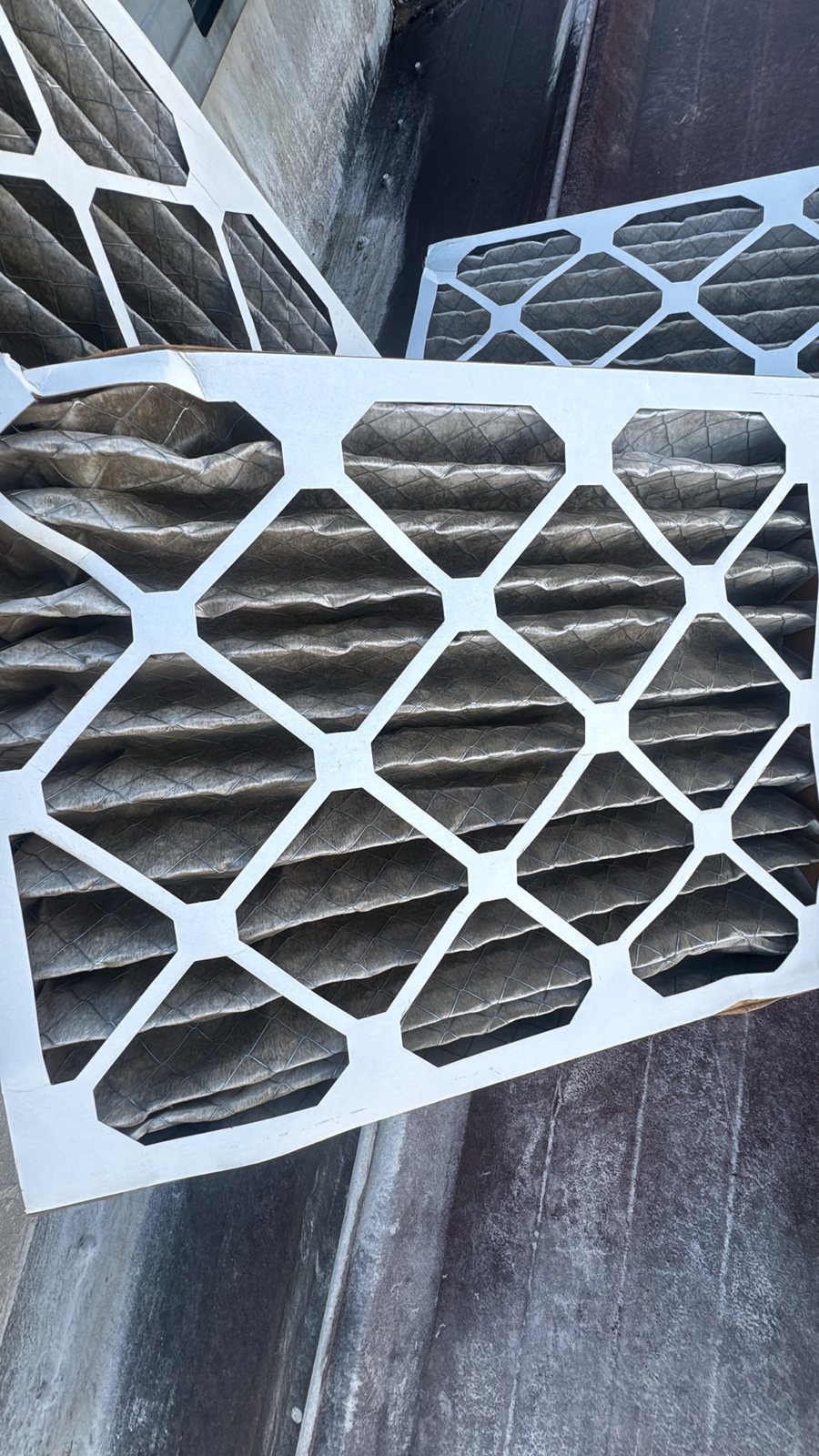
Here's a thing we see so often it has stopped surprising us. A family in Peachtree City calls because the upstairs never cools off, or a homeowner in Fayetteville calls because the furnace heats for five minutes and then quits. Our technician pulls the filter out of the slot, and it's gray. Not a little dusty. Gray and bowed in the middle, like a sail in the wind, sometimes with a hole sucked through it. The homeowner looks at it and says some version of the same sentence: "I didn't even know that was there."
That's the strange thing about the air filter. It's the cheapest part of a heating and air system, the only part most people are ever expected to touch, and it's hidden in a slot nobody looks at. Yet it sits at the one spot every bit of air in the house has to pass through, dozens of times a day. When it's clean, you never think about it. When it's clogged, it quietly sets off a chain of problems that end in a service call.
This guide explains what an air filter actually does, what those MERV numbers on the package mean, why a "better" filter can make your system worse, how often to change it in a Georgia home, and how to figure out which filter you need. The short version lives on our HVAC FAQ page. This is the long one.
| Your home | Check it | Replace it | Filter we usually suggest |
|---|---|---|---|
| One or two people, no pets, no allergies | Monthly | About every 90 days with a 1" filter | MERV 8 pleated |
| Pets in the house | Monthly | Every 30 to 60 days | MERV 8 to 11 pleated |
| Allergies or asthma in the family | Monthly | Every 30 days in pollen season | MERV 11 in a 1" slot, or MERV 13 in a media cabinet |
| Spring pollen season (roughly March to May) | Every few weeks | As soon as it looks yellow or gray | Your usual filter, changed more often |
| Construction, remodeling, or sanding inside | Weekly | As soon as it's loaded, then again after cleanup | MERV 8, changed often |
| 4" to 5" media filter cabinet | Every few months | About every 6 to 12 months, per the manufacturer | MERV 11 to 13 media |
| Vacation home or rarely used system | Each visit | At least twice a year | MERV 8 pleated |
What does an air filter actually do?
An air filter is a screen for your house's air. Your system pulls air from the rooms through the return grilles, pushes it across the furnace and the cooling coil, and sends it back out the vents. The filter sits in front of all that equipment and catches the dust, lint, hair, and pollen riding along before it gets inside the machine.
Most people assume the filter is there to clean the air they breathe. It does some of that. But its first job, the reason it was put there in the first place, is protecting the equipment. A furnace's heat exchanger, a blower wheel, and an evaporator coil are all built with small spaces for air to move through. Dust that gets past the filter sticks to the blower fins and the coil, and once it's there, it doesn't leave on its own.
The second job is the one homeowners care about: catching the small stuff that makes your nose run. Pollen, pet dander, mold spores, and fine dust all ride through the ducts. A good filter catches a lot of it. The EPA makes a point worth knowing, though: furnace and HVAC filters only filter the air when the system is running, and in most homes that's less than a quarter of the time during heating and cooling season. So the filter matters, but it isn't the only thing standing between your family and the pollen on the porch.
What does MERV mean on an air filter?
MERV is a score for how small a particle a filter can catch. Higher number, smaller particles. That's really the whole idea.
The letters stand for Minimum Efficiency Reporting Value. It comes from a lab test written by ASHRAE, the engineering society for heating and air. In the test, a filter is loaded with dust and measured on how well it captures particles in three size ranges, from 0.3 to 10 microns. For a sense of scale, a human hair is roughly 50 to 70 microns wide, so these are particles you can't see. The EPA's summary puts it simply: the higher the MERV rating, the better the filter is at trapping specific sizes of particles.
Here's roughly what the numbers mean in a house:
| MERV | What it catches well | Where you'll see it |
|---|---|---|
| 1 to 4 | Large dust, lint, carpet fibers | Flat fiberglass "rock catcher" filters |
| 5 to 8 | Plus pollen, dust mites, mold spores, and most household dust | Basic pleated filters, the everyday standard |
| 9 to 12 | Plus finer dust, pet dander, and skin flakes | Better pleated filters and many media filters |
| 13 to 16 | Plus very fine particles such as smoke and many bacteria | High-efficiency pleated filters and deep media cabinets |
The ratings stack on each other. A MERV 8 has to catch at least 70 percent of the 3- to 10-micron particles in the test and some of the 1- to 3-micron range. A MERV 13 has to catch at least half of the tiniest group, 0.3 to 1 micron, the size the EPA calls out for smoke and fine particle pollution. By MERV 16, it's 95 percent or better across every size range in the test, according to EPA's chart.
You'll also see other rating systems on store shelves. One brand uses MPR, another uses FPR with a color code. The EPA notes that MERV is based on a national consensus standard, while those others are proprietary. They're not wrong, they're just harder to compare. When you're standing in the aisle at the hardware store in Tyrone, look for the MERV number in the fine print.
Is a higher MERV filter always better?
No, and this is the part of the story that surprises people. A filter that catches more stuff is also harder for air to get through. If your system wasn't built for that, the "better" filter can make the whole system work worse.
Think of breathing through a cotton T-shirt, then through a winter scarf folded four times. The scarf stops more dust. It also makes your lungs work harder for every breath. Your blower is the lungs.
Technicians talk about this as pressure drop and static pressure. Every filter creates some resistance to airflow, measured as the drop in pressure from one side of the filter to the other. Add up the resistance of the filter, the ducts, the coil, and the grilles, and you get the system's total external static pressure, measured in inches of water column with a manometer. Every blower is designed to move a certain amount of air against a certain amount of resistance. Push past that and one of two things happens, depending on the motor:
- An older, standard (PSC) blower motor just moves less air. The fan spins the same, but less air comes out of the vents.
- A newer variable-speed (ECM) blower motor fights back. It ramps up to try to keep airflow where it should be, which means more noise, more electricity, and more heat and wear on the motor.
Either way, the system is struggling. And a high-MERV filter that's dirty is the worst of both worlds: dense to begin with, and loaded on top of that.
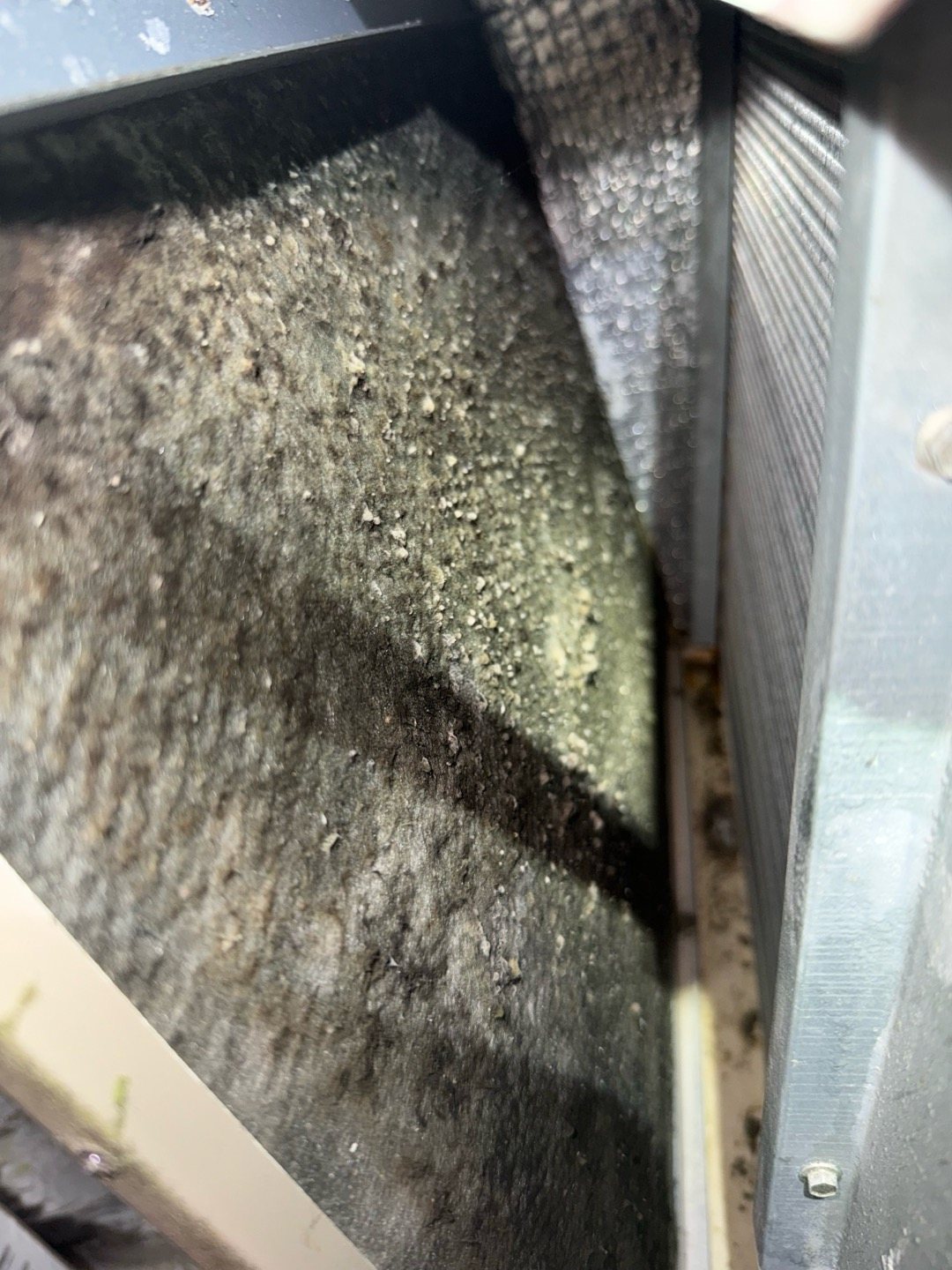
The good news: the EPA says that most furnaces and HVAC systems can accommodate a MERV 13 filter without creating equipment problems, provided that the filter is replaced frequently. The catch is that last phrase, and the fact that a lot of systems we see across Fayette and Coweta County have ductwork and return grilles that were sized tight to begin with. The EPA itself suggests a professional check the system before you go higher. That's why we usually recommend MERV 8 to 11 in a 1-inch slot, and save MERV 13 for a deeper media filter that has room to breathe.
What happens to your system when the air filter gets clogged?
A clogged filter doesn't break your system all at once. It starves it of air, a little more each week, and each part of the system reacts in its own way.
Here's what that chain looks like in summer and in winter.
In summer, the cooling coil freezes. Your indoor coil (the evaporator) is cold, often near freezing, and it depends on a steady stream of warm house air to keep it from getting colder. Choke the airflow and the coil drops below 32 degrees. The moisture it pulls out of the air freezes onto it, the ice blocks even more air, and within a few hours you can have a block of ice inside your air handler and warm air coming out of the vents. When it thaws, all that water has to go somewhere, and it sometimes overwhelms the drain pan. Our post on why your AC is running but not cooling walks through frozen coils in detail.
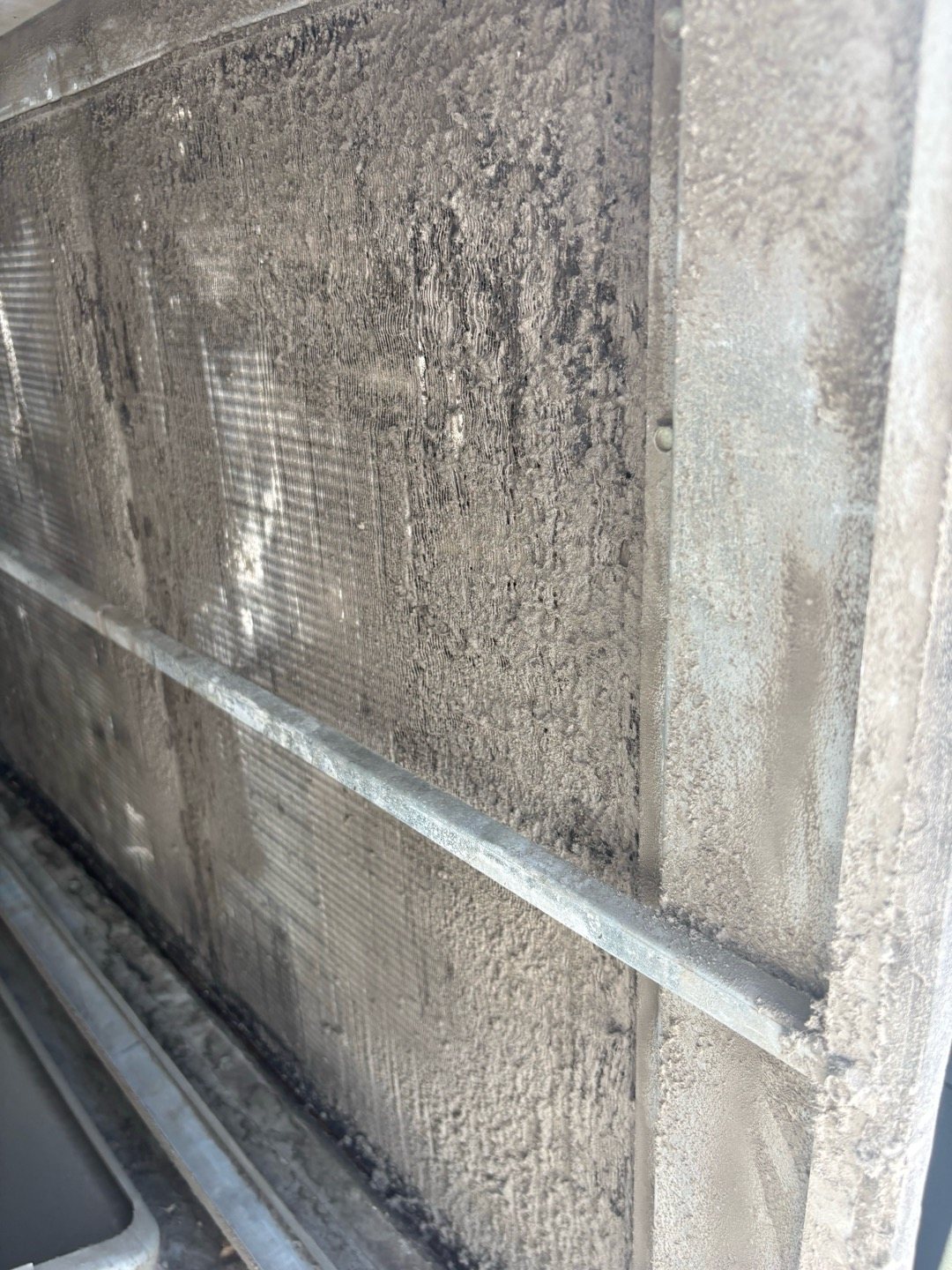
In winter, the furnace overheats and shuts itself off. A gas furnace needs a certain amount of air moving across its heat exchanger to carry heat away. When the filter is clogged, the metal gets hotter than it's supposed to. A safety device called the limit switch notices and shuts the burners off. The blower keeps running to cool things down, the limit switch resets, the burners light again, and the cycle repeats. To you, it looks like a furnace that heats for a few minutes and quits. Trane lists a dirty filter as a common cause of a furnace burner shutting off after it lights, because restricted airflow makes the heat exchanger overheat. Do that all winter, year after year, and the heat exchanger takes a beating it was never meant to. Our guide to why a furnace or heat pump stops heating covers limit switches and short cycling.
A heat pump runs longer and leans on backup heat. With less air moving across the indoor coil, a heat pump in heating mode can't move as much heat into the house. It runs longer, the head pressure climbs, and the thermostat is more likely to call on the electric heat strips to help.
The blower works harder all year. Higher static pressure means the blower motor is either moving less air or working harder to move the same air, and both shorten its life.
Dust goes where it shouldn't. A filter that's overloaded can bow, collapse, or pull loose from its frame, and once air can get around the edges, the dust goes straight to the coil and blower. A filter that doesn't fit its slot does the same thing.
ENERGY STAR sums it up in one sentence: a dirty filter can increase energy costs and damage your equipment, leading to early failure. It's the cheapest prevention in the whole system.
How often should you change your air filter in Georgia?
Look at it every month. Change it every one to three months, sooner if you have pets, allergies, or it's pollen season. That's the honest answer, and it's the same one ENERGY STAR gives: inspect, clean, or change air filters once a month in your air conditioner, furnace, or heat pump.
Why the range? Because "how often" depends on how fast your house makes dust, and every house is different. The best test is your eyes. Pull the filter and hold it up to a light. If light comes through easily and the pleats are still mostly white, it can go back in. If it's gray, you can't see light through it, or it's bowed in the middle, replace it.
A few things are particular to living in Tyrone, Peachtree City, Fayetteville, Newnan, Senoia, and the rest of South Atlanta:
- Our systems run most of the year. In a lot of the country, there are months when neither the heat nor the air runs. Here, the AC runs from April into October, and the heat picks up in November. A filter that runs nine months a year loads up faster than one that runs six.
- Spring pollen season is its own season. If you've ever seen the yellow-green film on cars around Peachtree City's golf cart paths in late March and April, you've seen what your return grilles are pulling into the filter. Check it every few weeks during pollen season.
- Fall leaves, pine pollen, and dust. Pine trees across Fayette and Coweta County shed pollen too, and dry fall weather means more dust in the house.
- Older homes and crawlspaces. Leaky return ducts in an attic or crawlspace can pull insulation fibers and dust right into the system, which can load a filter faster than you'd expect.
How do pets and allergies change how often you should replace a filter?
Pets shed, and that hair and dander goes into the return. Allergies make you feel every bit of it. Both are good reasons to change your filter more often, and allergies are a good reason to think about a better filter, too.
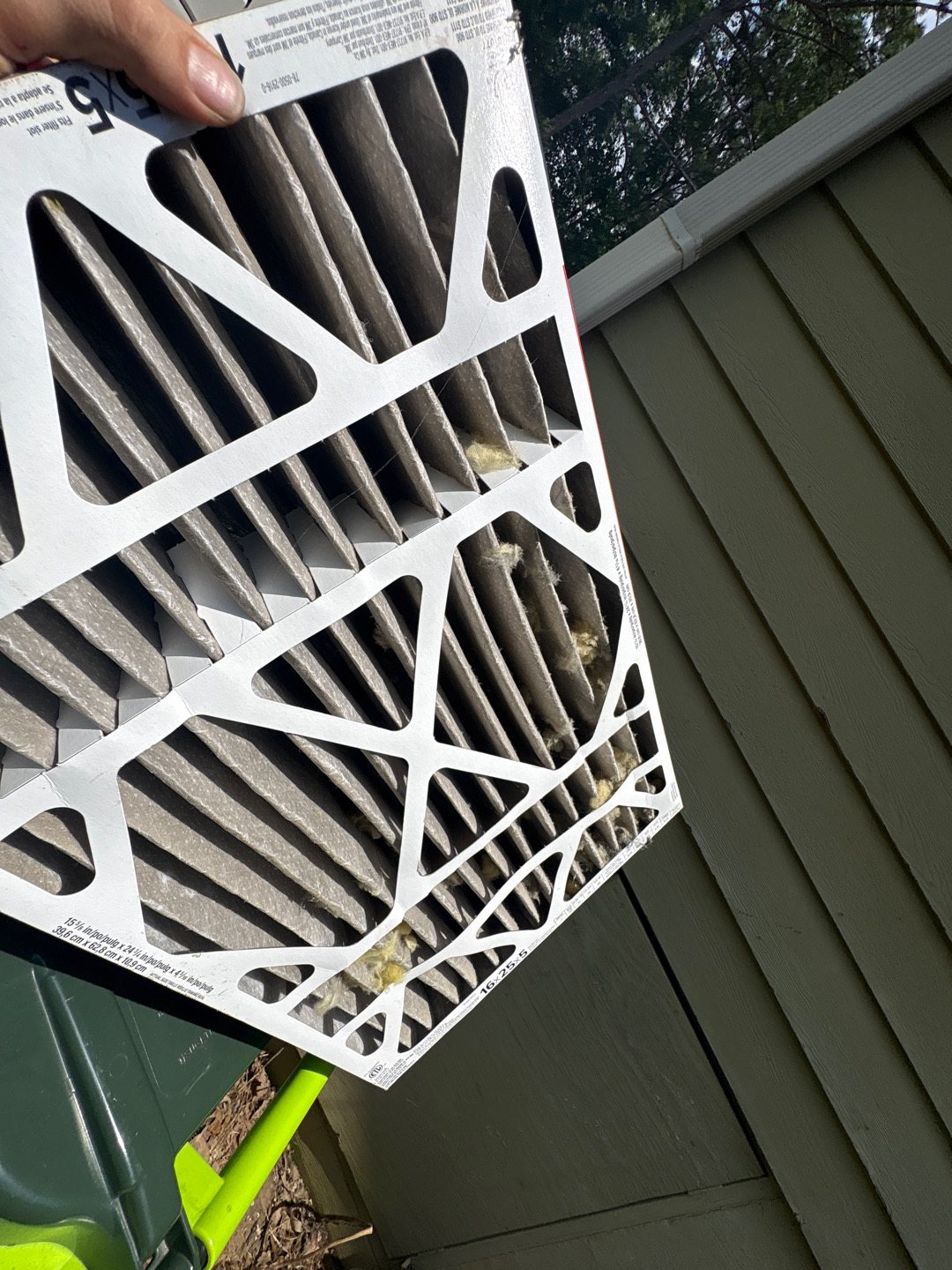
If you have dogs or cats, plan on checking monthly and changing every 30 to 60 days. Pet hair is big and easy to catch, so it fills the face of the filter fast. Dander is much smaller, and that's where a MERV 11 does better than a MERV 8. Trane's MERV guide lists pet dander among the particles a MERV 11 filter catches that a basic 1-inch MERV 8 doesn't.
If someone in the house has allergies or asthma, change it monthly during pollen season and consider stepping up to MERV 11, or to MERV 13 in a media cabinet. But keep expectations honest. A filter only works when the system is running, and the EPA notes that filtration is one part of the picture, along with keeping the source of the allergens down and bringing in clean air. Vacuuming with a good vacuum, washing bedding, and keeping windows shut on high-pollen days all help. If allergies are a real problem in your house, our indoor air quality team can talk through what actually helps.
If you just set the fan to "On" to get more filtering, know the tradeoff. Running the blower nonstop does filter more air, but the EPA points out that it uses more electricity, and in summer it can make humidity control worse, because water on the coil gets blown back into the house between cooling cycles. In a humid Georgia summer, that's a real cost.
What's the difference between a 1-inch filter and a 4- or 5-inch media filter?
A 1-inch filter is thin. A 4- or 5-inch media filter is the same idea, but deep and folded up like an accordion, so it has far more filter material packed into the same opening. More material means the air spreads out across a bigger area and moves through it more slowly.
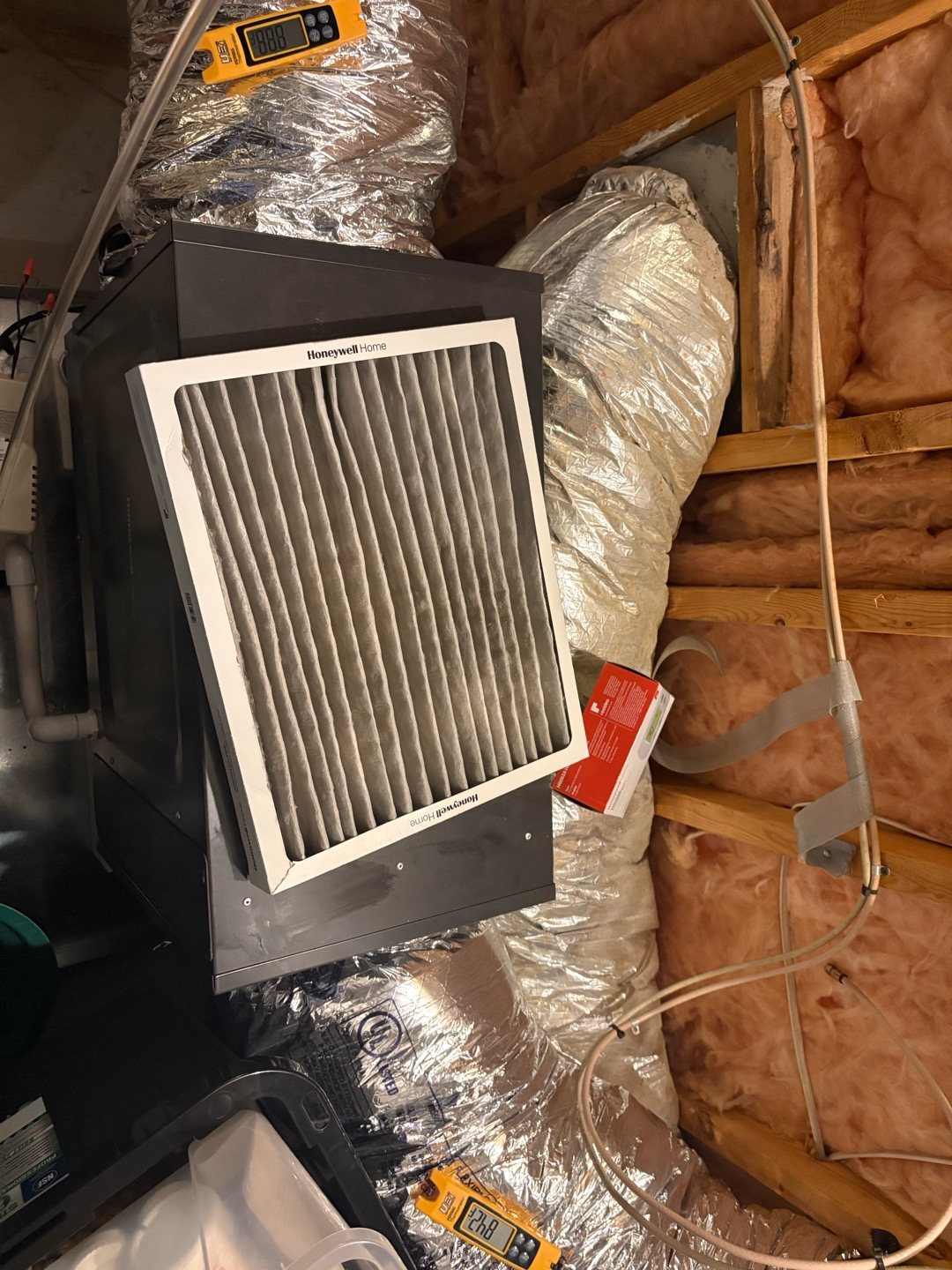
Here's why that matters. Remember pressure drop? It depends a lot on how fast the air is moving through the filter material. Spread the same amount of air over five or ten times as much surface, and each square inch of filter sees much slower air. That's how a 4-inch MERV 13 media filter can catch fine particles while creating no more resistance than a thin, dense 1-inch filter, and often less. It also holds a lot more dirt before it loads up.
| 1" filter | 4" to 5" media filter | |
|---|---|---|
| Where it goes | A slot in the furnace or air handler, or behind a return grille | A dedicated cabinet installed next to the furnace or air handler |
| Typical rating | MERV 1 to 13 | MERV 8 to 16 |
| Airflow resistance at the same MERV | Higher | Lower, because of the extra surface area |
| How often to change it | Every 1 to 3 months | About every 6 to 12 months, per the manufacturer |
| Best for | Most homes, with a MERV 8 to 11 pleated filter | Allergies, pets, homes that want MERV 13 without strain |
Two notes from the field. First, a media cabinet has to be installed correctly, with the cabinet sealed to the ductwork. A leaky cabinet lets air go around the filter, and then the rating on the box doesn't matter. Second, don't try to cram a 2-inch or 4-inch filter into a slot built for 1 inch, or tape two filters together. If you want a deeper filter, it needs a cabinet built for it.
Where is my air filter, and how do I read the filter size?
Your filter is usually in one of two places: a slot at the furnace or air handler, or behind a return grille in a wall or ceiling. Some homes have both, and some have one filter grille for each return.
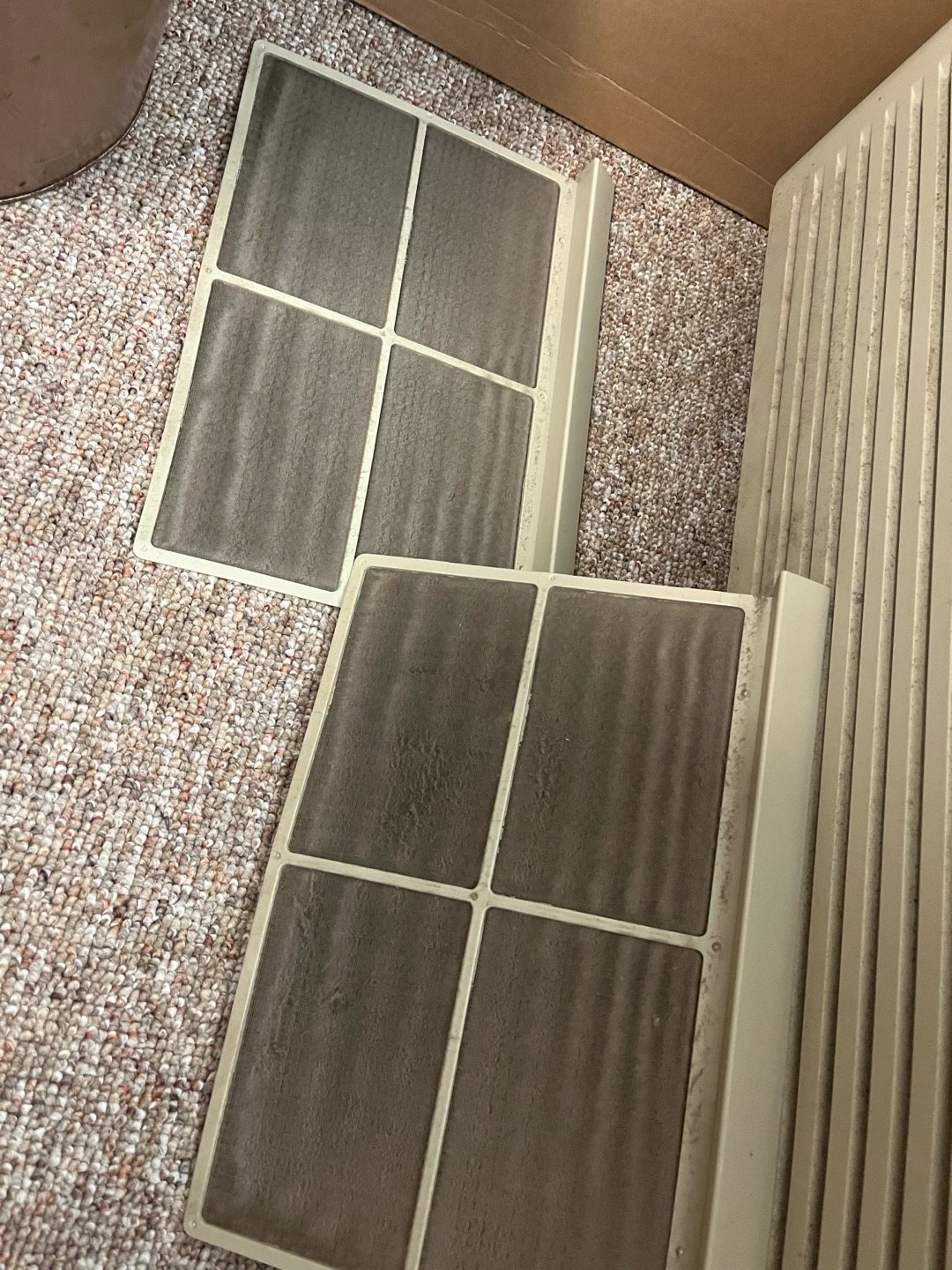
At the furnace or air handler. In a lot of Fayette and Coweta County homes, the system is in the attic, a hall closet, the garage, or a basement or crawlspace. Look for a thin metal slot with a removable cover, usually on the side of the unit where the big return duct comes in, or a door on the front of the air handler.
At a return grille. Look for a larger grille, often in a hallway ceiling or wall, with clips or thumbscrews on one edge. Open it, and the filter is right behind it.
If you can't find it, call us. Some homes have a filter in a spot nobody would think to look. And some homes, believe it or not, have no filter at all.
How to read the filter size. The size is printed on the edge of the frame, in inches: width by height by depth. A label that says "16 x 25 x 1" means 16 inches by 25 inches by 1 inch deep. That's the nominal, or rounded, size. The actual size printed in smaller type next to it is usually a little smaller, like 15.5 x 24.5 x 0.75, so it slides into a 16 x 25 slot. Buy by the nominal size printed on your old filter.
A few more things to look for while you're there:
- The airflow arrow. Every filter has an arrow on the frame. It points toward the blower, in the direction the air moves. At a ceiling return grille, that usually means pointing up into the ceiling. At the furnace, it points toward the unit.
- A snug fit. If you can slide your fingers down the sides of the filter in its slot, air is going around it. Get the right size.
- More than one filter. If your home has two or three returns with filter grilles, every one of them needs a fresh filter.
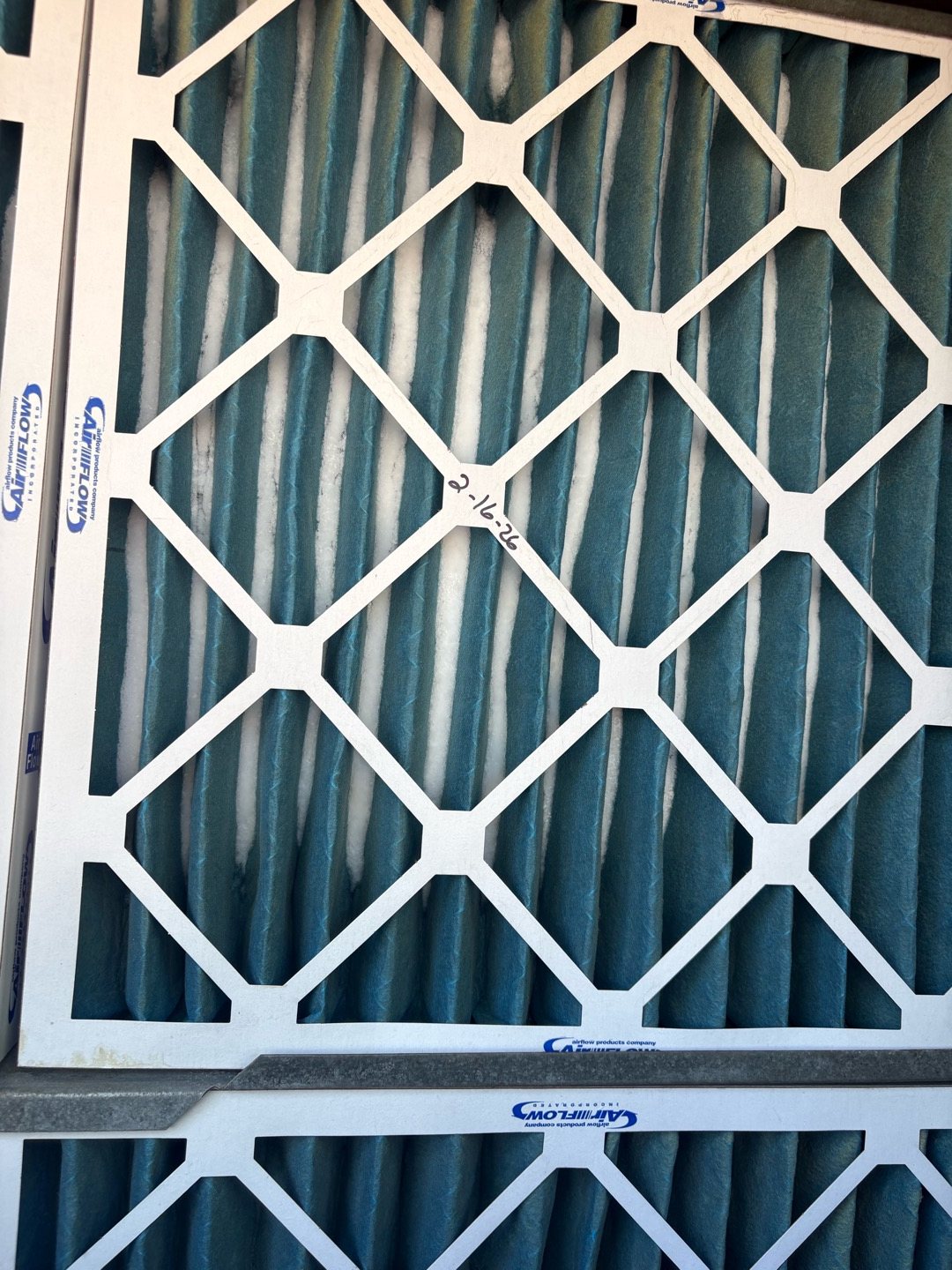
- Write the date on the frame with a marker when you put the new one in. Next month, you'll know exactly how long it's been.
Do washable, electrostatic, or "allergen" filters work better?
Sometimes. It depends on what's printed on the package, not the name on the front.
- Flat fiberglass filters are the thin, blue or green see-through kind. They're usually MERV 1 to 4. They protect the equipment from big stuff, but they don't do much for your air.
- Pleated filters are the everyday standard. Most are MERV 8 to 13. The pleats add surface area, which helps with both capture and airflow.
- Washable filters can save trips to the store, but they're often low-MERV, and they have to be completely dry before they go back in. A damp filter in a dark duct is a place for mold to grow.
- Electrostatic filters use a static charge to grab particles. Some perform well, but the charge can fade as the filter loads, so the real-world performance can drop over time.
- "Allergen," "allergy," or "ultra" filters are marketing names. Look for the MERV number. If it's MERV 13 or higher in a 1-inch frame, check with us first, especially if your returns are small or your system already struggles in August.
What's the right MERV rating for your home in Fayette and Coweta County?
For most homes, here's how we'd choose:
- Most homes with a 1-inch slot: MERV 8 pleated, changed every one to three months.
- Pets in the house: MERV 8 to 11 pleated, changed every 30 to 60 days.
- Allergies or asthma: MERV 11 pleated, changed monthly in pollen season. If you want MERV 13, talk to us about a 4- or 5-inch media cabinet.
- Smoke from wildfires or a smoker in the home: MERV 13, ideally in a media cabinet, with a check of the system's static pressure first.
- Older systems that already struggle on hot days: stay at MERV 8 until we've looked at the airflow. A struggling system doesn't need more resistance.
If you're not sure your system can handle a higher rating, that's not a question you should have to guess at. A technician can measure the static pressure with the filter in place and tell you, with a number, whether your system has room for it.
How does a John Davis technician check your filter and airflow?
At every tune-up, we do more than swap the filter. We check whether the filter is right for the system.
- We look at what's in there. How loaded is the filter, is it the right size, is it sealed, and is the airflow arrow pointing the right way?
- We look past it. Dust on the blower wheel or the coil tells us whether air has been getting around the filter.
- We measure static pressure. With a manometer, we measure the pressure in the return and supply sides of the system and compare it to what the blower was designed for. That tells us whether the filter, the ducts, or the returns are holding the system back.
- We check the temperatures. In summer, we check the temperature drop across the coil. In winter, the temperature rise across the furnace. Both shift when airflow is wrong.
- We recommend a filter that fits. That might be a MERV 8 that you change more often, a MERV 11, or a media cabinet if you want better filtration and the system needs more filter area.
If the filter is fine but airflow still isn't, the problem is somewhere else, often undersized returns, crushed or leaky ductwork, a dirty blower wheel, or a dirty coil. Those are the things a preventative maintenance visit is designed to catch. Our guide on how often to service your heating and AC explains what a real tune-up includes. And if a clogged filter has already led to a problem, our HVAC repair and heating services pages cover what happens next.
How does the JD Air Care Plan help with air filters?
If you'd rather not keep track of filter changes yourself, the JD Air Care Plan takes a lot of that off your plate. Plans start at just $15 a month, and members get:
- Free standard filters
- Two tune-ups a year, spring for cooling and fall for heating, with the filter and airflow checked each time
- A $0 service fee when you need us
- Priority scheduling, so members get seen first when the weather turns
- 10% off repairs
The real value is in what doesn't happen: the frozen coil in July that never forms, the furnace that doesn't trip its limit switch on the first cold night, the blower motor that isn't worn out years early. Our phone line is answered 24/7, so you can always reach a person to get on the schedule. See the membership page for full details.
Air filter questions? Get Service Now
If you're not sure what filter your system needs, or a clogged filter has already left you with a frozen coil or a furnace that keeps shutting off, call John Davis Heating & Air at 770-299-2833. We're a family-owned company working out of our shop at 1525 Senoia Rd Suite G in Tyrone, and we've been taking care of homes across South Atlanta since 1968, including HVAC repair in Tyrone, Peachtree City, Fayetteville, Newnan, and Senoia, plus the rest of Fayette County and Coweta County. See all of our service areas.