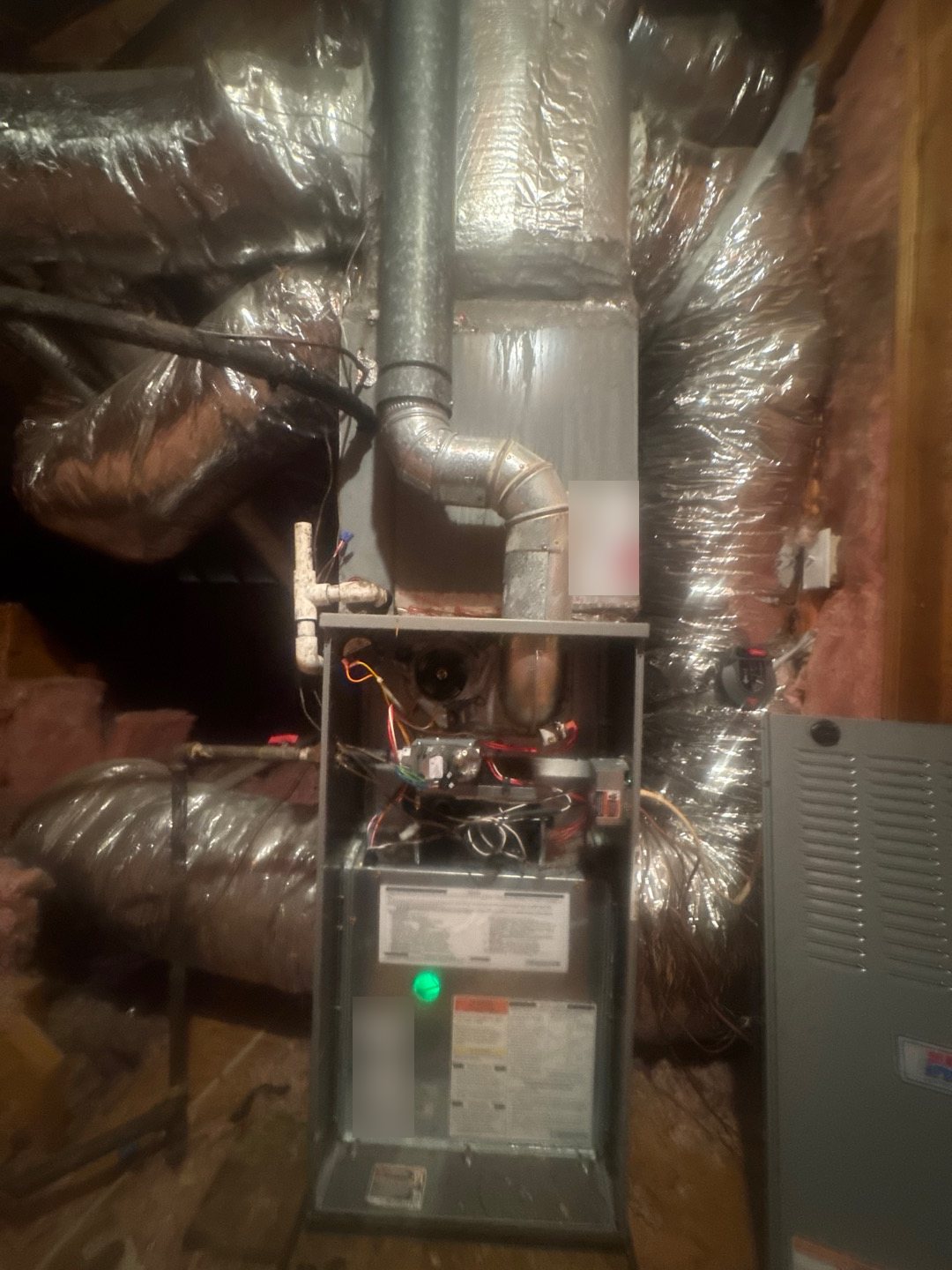
The first cold snap of the year has a sound in our office. The phones start ringing on a Tuesday morning in late October or early November, after the first night that dips into the 30s, and the calls all start the same way. "I turned the heat on for the first time and nothing happened." Or: "It's blowing, but it's blowing cold." Or the one that worries people most: "It runs for a minute, then it shuts off, then it tries again."
It's a strange moment for a heating system. In Tyrone, Peachtree City, Fayetteville, Newnan, and Senoia, a furnace can sit idle from March to November while the air conditioner does all the work. Dust settles on the burners. A spider moves into the flame sensor's neighborhood. A condensate line that drained fine all summer picks up sludge. Then one night the thermostat asks for heat, and every part that's been waiting quietly for eight months has to work at once.
This guide walks through how a gas furnace and a heat pump actually make your house warm, what you can safely check yourself, what each symptom usually points to, and when to shut it off and call a professional. The short version lives on our HVAC FAQ page. This is the long one.
| What you notice | What it usually means | What to do |
|---|---|---|
| Nothing happens when you call for heat | Thermostat setting or batteries, a tripped breaker, the furnace power switch, or a door safety switch | Check the thermostat, breaker, switch, and blower door, then call |
| Furnace clicks or hums but never lights | Igniter, gas supply, or a safety switch stopping the start-up | Don't keep resetting it; call us |
| Burners light, then shut off within seconds | Dirty or failing flame sensor | Call for a cleaning and test |
| Heat runs a few minutes, shuts off, repeats | Overheating from a clogged filter or dirty blower, or a limit switch | Check the filter, then call |
| Fan blows cold air from a gas furnace | Burners aren't lighting, or the fan is set to On instead of Auto | Set the fan to Auto, then call if it continues |
| Heat pump blows cool air for a few minutes, then warms up | Normal defrost cycle | Wait it out; call if it lasts over an hour |
| Outdoor heat pump unit is caked in ice and stays that way | Defrost control, sensor, or refrigerant problem | Call us |
| "Aux" or "Emergency Heat" runs constantly, bills jump | Heat pump not carrying its share of the load | Call for a heat pump check |
| Gas smell, rotten-egg odor | Possible gas leak | Leave the house, then call 911 or Atlanta Gas Light |
How does a gas furnace actually heat your house?
A gas furnace is a controlled campfire in a metal box, with a fan that blows house air past the outside of the box. The fire never touches the air you breathe. It heats the metal, the metal heats the air, and the smoke goes up a pipe and out of the house.
Most homes in Fayette and Coweta County with gas heat have a central forced-air furnace. The Department of Energy describes them simply: furnaces are the most common way to heat a home in the United States, and central forced-air furnaces distribute heated air through the house via ducts, with most of them burning natural gas.
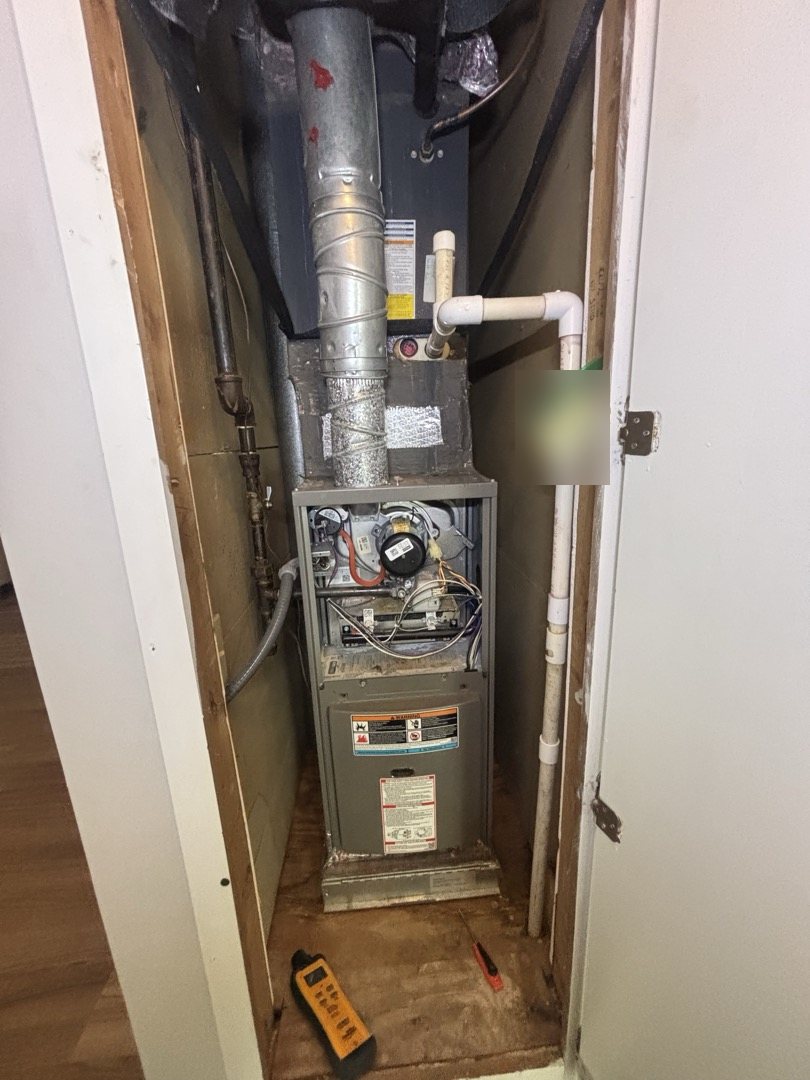
What's interesting is how careful the machine is. A modern furnace doesn't just open the gas and hope. It runs a little checklist every single time it starts, and if any step fails, it quits. Here's the sequence on a typical furnace with electronic ignition:
- The thermostat calls for heat. It's a low-voltage signal, basically a switch closing.
- The draft inducer motor starts. This small fan pulls air through the heat exchanger and pushes exhaust out the vent, so the flue is clear before any fire happens.
- A pressure switch proves the draft. If the vent is blocked or the inducer is weak, the pressure switch never closes, and the furnace stops right here.
- The igniter heats up. On most furnaces it's a hot surface igniter that glows orange like a toaster element.
- The gas valve opens and the burners light.
- The flame sensor confirms there's a flame. If it doesn't see one within a few seconds, the control board shuts the gas off. Trane puts it plainly: the flame sensor is there so the gas valve only opens while flames are burning, which prevents gas from building up.
- The blower starts once the heat exchanger has warmed up, so you don't get a blast of cold air.
- A limit switch watches the temperature the whole time. If the furnace gets too hot, usually because not enough air is moving across it, the limit switch shuts the burners off.
That checklist is why a furnace not heating can have so many possible answers. Each step is a door, and a furnace that won't heat is a furnace stuck at one of those doors. The good news is that the control board usually knows which door. Most furnaces have a small status light behind the panel that blinks a code, and the chart that explains it is printed on the inside of the furnace door.
How does a heat pump heat your house in a Georgia winter?
A heat pump is an air conditioner that can run backward. In summer it pulls heat out of your house and dumps it outside. In winter it pulls heat out of the outdoor air, even cold air, and brings it inside.
That sounds like a trick, because 35-degree air doesn't feel like it has any heat to give. But it does. The refrigerant in the outdoor coil is colder than the outdoor air, so heat flows into it, the same way heat flows from your hand into an ice cube. The compressor then squeezes that refrigerant until it's hot, and the indoor coil releases the heat into your ductwork. DOE describes it as collecting heat from the outside air and concentrating it for use inside, and notes that heat pumps can provide up to three times more heat than the energy they use.
That efficiency is why heat pumps are so common across South Atlanta, where our winters are mild most of the time. It also explains the two things that confuse heat pump owners most.
The air feels cooler than a furnace. A gas furnace makes air that feels hot on your hand. A heat pump makes air that's warm, but cooler than your skin, so it can feel lukewarm at the vent even while it's heating the house correctly. That's how it's built.
It needs backup on the coldest days. As the outdoor temperature drops, there's less heat to pull out of the air, and the heat pump has to run longer. Most heat pumps in our area have electric heat strips, called auxiliary heat, that kick in to help. Trane notes that auxiliary heat will usually come on when the outside temperature is below about 40 degrees, during defrost, or if you raise the thermostat by more than 3 to 4 degrees at once. Some homes have a dual-fuel setup, a heat pump paired with a gas furnace, where the furnace takes over in the cold instead of electric strips.
What should you check first when your furnace is not heating?
Start with the dull stuff. The dull stuff turns out to be the answer more often than anyone wants to admit, and none of it requires a tool.
- Thermostat set to Heat, and set above the room temperature. After a summer on Cool, the thermostat may still be on Cool, Off, or a schedule nobody remembers programming. If the screen is blank or dim, put in fresh batteries. Trane lists human error and a faulty thermostat as the first two things to rule out when a furnace isn't turning on.
- Fan set to Auto, not On. With the fan on "On," the blower runs all the time, including between heating cycles, so you'll feel cool air coming out of the vents and think the furnace is broken.
- Breaker and furnace switch. A gas furnace still needs electricity for its blower, igniter, and control board. Look for a switch near the furnace that looks like a light switch, and make sure it's on. Then check the breaker panel. If the breaker has tripped, Trane advises not resetting it, because a furnace that trips a breaker usually has a problem worth finding. Call us instead.
- The blower door. Most furnaces have a safety switch that kills power when the bottom panel isn't seated. If someone changed the filter and didn't push the door all the way closed, the furnace won't run.
- Air filter. Pull it out and hold it up to a light. If you can't see light through it, replace it. DOE recommends you clean or replace furnace filters once a month or as recommended. A clogged filter is one of the most common reasons a furnace heats for a few minutes and then shuts off.
- Gas supply. If your stove or water heater also runs on gas and isn't working, the problem may be the gas service, not the furnace. The furnace's own gas shutoff is usually a small lever on the pipe leading to it. If you're not sure, leave it alone and call.
- Vents and returns. Make sure supply registers are open and return grilles aren't blocked by furniture, rugs, or a stack of boxes.
- The outdoor unit, if you have a heat pump. Look for leaves, pine straw, or ice piled around or on top of it.
If all of that checks out and your furnace is still not heating the house, it's time for a professional. Here's what we're usually looking at once we get there.
Why is my furnace blowing cold air?
When a gas furnace blows cold air, the blower is working but the fire isn't. Either the burners never lit, or they lit and then shut off, and the fan is still running to move whatever air is in the ducts.
Before anything else, check the fan setting. If it's on "On" instead of "Auto," cold air between cycles is normal. If the fan is on Auto and the air never warms up, the furnace is stuck somewhere in that start-up checklist. Many furnaces will try to light a few times, then lock themselves out for a while before trying again. That lockout is a safety feature, and it's the reason a furnace sometimes "fixes itself" and then fails again the next morning.
The most common reasons a furnace blows cold air:
- A dirty flame sensor. More on this below. It's the classic "lights, then quits" problem.
- A failed igniter. Hot surface igniters are brittle and wear out. If the igniter doesn't glow, the gas never lights.
- A tripped safety switch. A pressure switch, limit switch, or rollout switch can stop the burners while letting the blower run to cool things down.
- A clogged condensate line on a high-efficiency furnace. The furnace senses the water backing up and refuses to fire.
- A gas supply problem. A closed valve, a gas service issue, or a failing gas valve.
If you have a heat pump and it's blowing cool air, read the heat pump sections further down. That's a different story with a different list of suspects.
Why does my furnace turn on and then shut off?
This one feels like the furnace is teasing you. The burners light, the house starts to warm up, and then everything goes quiet. A few minutes later, it tries again. HVAC people call it short cycling, and it's almost always a safety device doing its job.
There are two common versions of this.
The burners light and go out within a few seconds. That's usually the flame sensor. The flame sensor is a thin metal rod that sits in the flame. When the burners light, the flame carries a tiny electrical current, measured in millionths of an amp, from the rod back to the furnace. The control board reads that current as proof there's a flame. Over time the rod picks up a thin coating from combustion, and the current gets weaker. Eventually the board can't tell there's a flame, so it shuts the gas off to be safe. Trane notes that a dirty or faulty flame sensor can turn off the furnace prematurely, and that cleaning or replacing it may fix the problem. Trane also says homeowners should not attempt to clean or replace the flame sensor themselves, and we agree. It sits right next to the burners and the gas valve.
The furnace heats for several minutes, then shuts off. That's usually the limit switch, and the limit switch is usually reacting to airflow. A furnace is designed to have a certain amount of air moving across the heat exchanger. If the air can't get through, the metal gets too hot, and the limit switch shuts the burners off until it cools down. Trane lists a dirty furnace filter as a common cause, because restricted airflow can make the heat exchanger overheat and trip the limit switch.
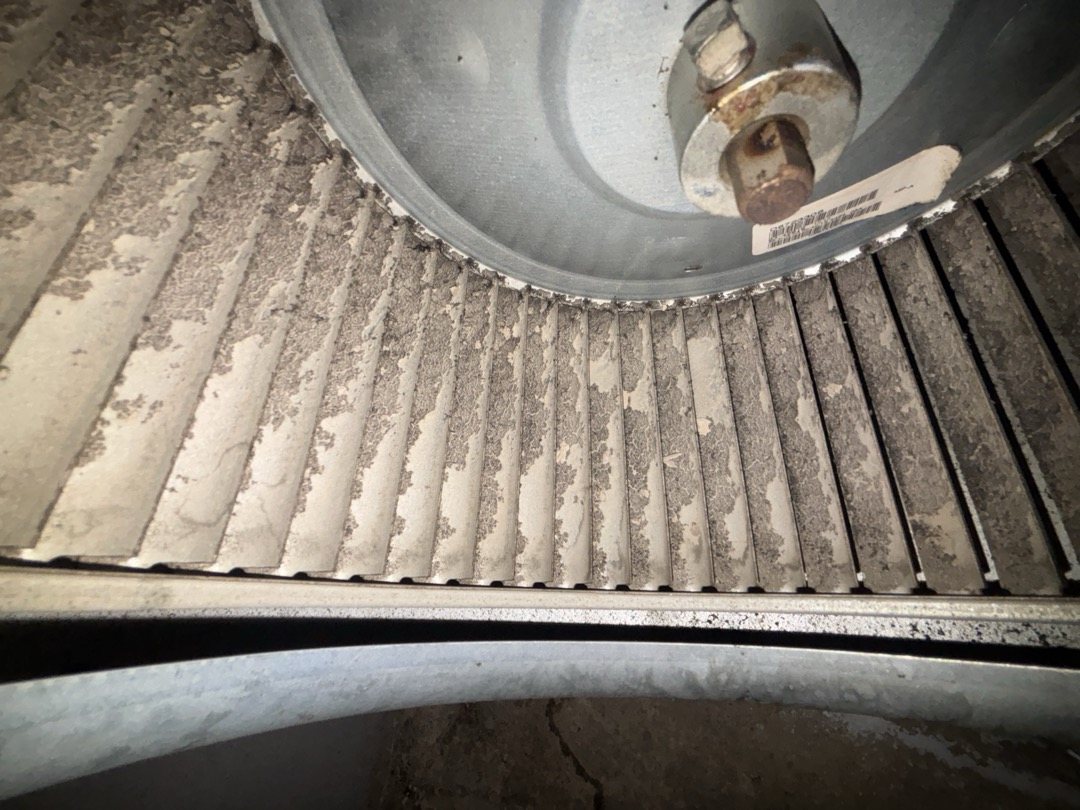
The filter isn't the only thing that can choke airflow. A blower wheel packed with dust, closed or blocked vents, a weak blower motor or capacitor, a collapsed duct in the attic, or a dirty indoor AC coil sitting on top of the furnace can all do it. The limit switch doesn't know which one it is. It just knows the furnace is running hot.
A furnace that short cycles on its limit switch over and over is working harder than it should, and repeated overheating is hard on the heat exchanger. If changing the filter doesn't fix it, call us.
Why won't my furnace ignite?
If you can hear the furnace start, the inducer fan whir, maybe a click or two, and then nothing, the furnace is getting stuck before the flame. Trane walks through the usual suspects for a furnace that clicks but won't ignite: power, the gas supply, the igniter, and the flame sensor.
Here's how a technician narrows it down:
- Is the igniter glowing? A hot surface igniter that doesn't glow either has failed or isn't getting power. Igniters crack with age, and a hairline crack you can barely see is enough to stop it. Trane notes that furnaces built since 2010 use electronic ignition rather than a standing pilot light.
- Did the pressure switch close? If the inducer runs but the pressure switch never proves the draft, the control board won't let the igniter start. That points to a blocked vent, a cracked or water-filled pressure hose, a weak inducer motor, or a clogged condensate trap.
- Is gas getting to the burners? A technician checks the gas valve and the gas pressure with a manometer.
- What does the status light say? The blink code on the control board is the furnace telling us which step failed.
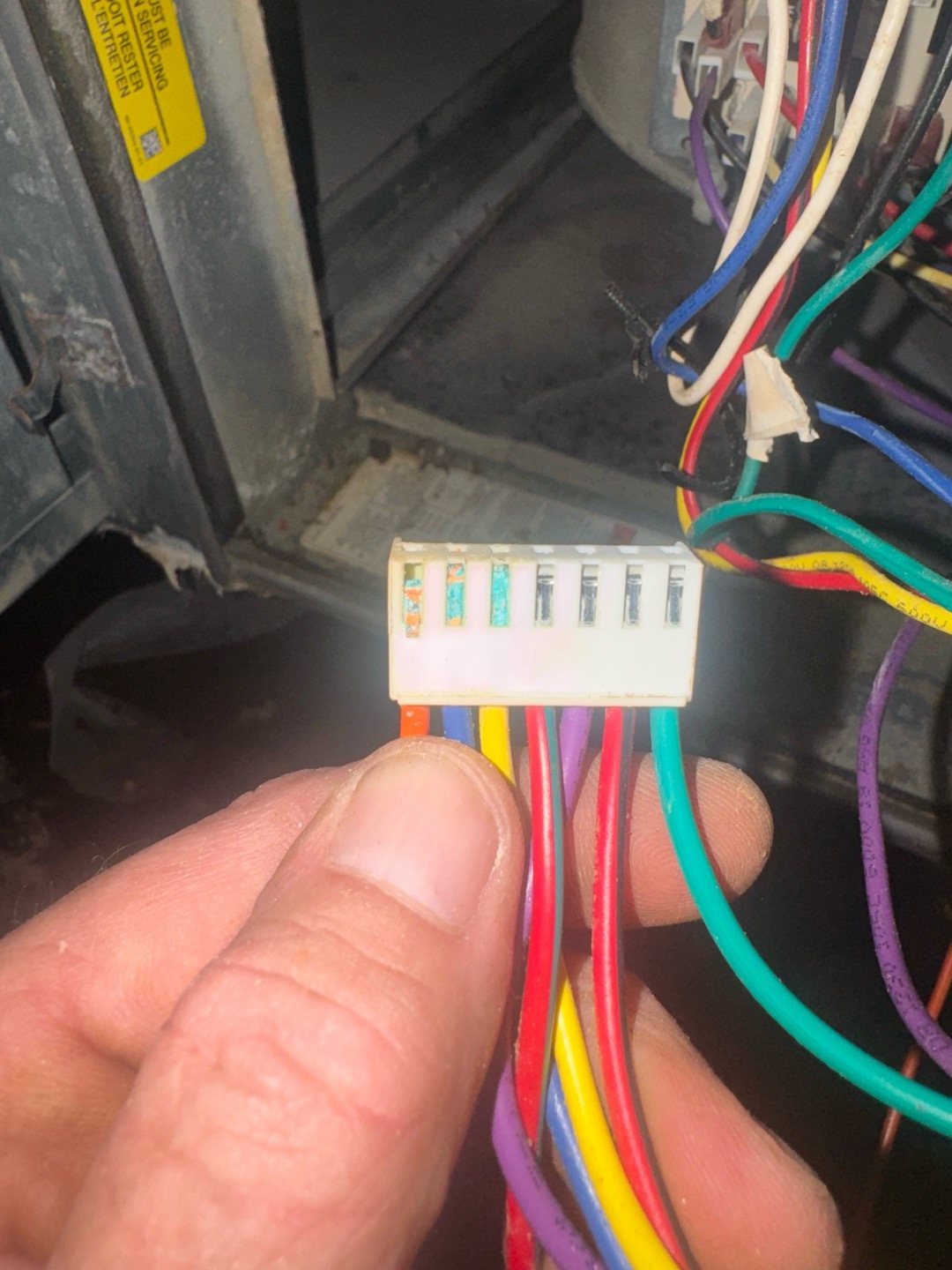
Older furnaces with a standing pilot light have their own version of this. If the pilot goes out and won't stay lit, it's usually the thermocouple, a small sensor that keeps the gas valve open only while the pilot flame is heating it. Trane says you can try relighting a pilot by following the instructions on the furnace, but if the pilot light won't stay lit, call in the professionals.
One thing not to do: don't keep flipping the power off and on to force the furnace through more tries. Each lockout is the furnace protecting itself and your house. A few failed attempts tell us something useful. A dozen just fill the heat exchanger with unburned gas and frustration.
Could a clogged condensate line stop a high-efficiency furnace?
Yes, and it surprises a lot of people, because they think of water as an air conditioner problem.
A high-efficiency furnace squeezes so much heat out of its exhaust that the water vapor in the exhaust condenses into liquid, the same way your breath fogs a cold window. That's why these furnaces vent through white PVC pipe instead of metal: the exhaust is cool enough for plastic, and it's wet. DOE suggests asking your contractor about models with high annual fuel utilization efficiency (AFUE).
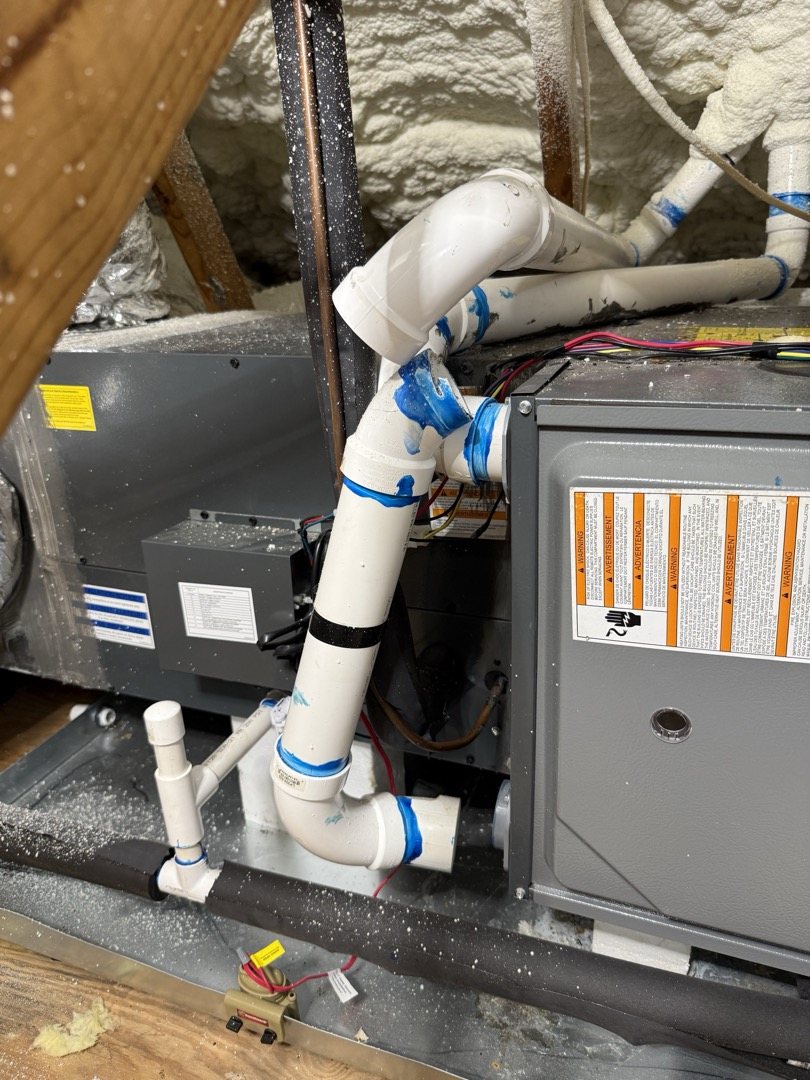
All that water has to drain somewhere, through a trap and a small line to a floor drain, a condensate pump, or outside. If the trap clogs with sludge, the line freezes or sags, or the condensate pump fails, water backs up into the furnace. When that happens, the pressure switch can't prove a safe draft, and the furnace won't light. Some systems also have a float switch that cuts power when water rises.
It's a sneaky problem in our area because the same drain line often serves the AC in summer, and a line that was barely draining in August can quit in November. If you have a high-efficiency furnace in the attic, check the pan under it. Water in the pan, or a gurgling sound when the furnace tries to start, is worth a call.
Is a cracked heat exchanger dangerous?
This is the one that matters most, so it's worth slowing down.
The heat exchanger is the metal wall between the fire and the air you breathe. Combustion gases, including carbon monoxide, travel through the inside of it and out the flue. Your house air travels across the outside of it. As long as that metal is intact, the two never mix. If the metal cracks or rusts through, combustion gases can leak into the air your blower is pushing through the house.
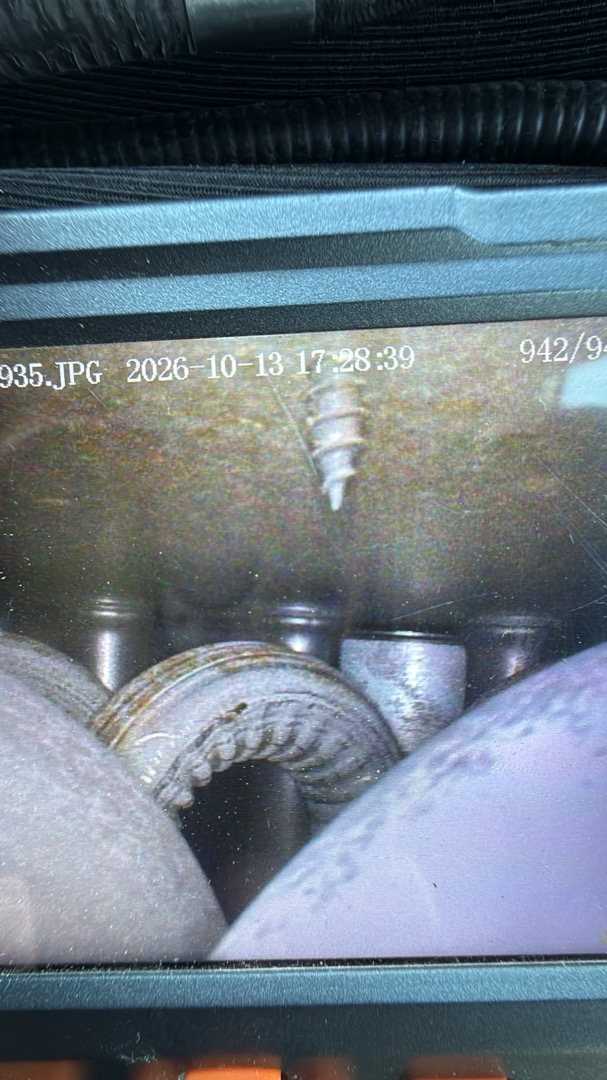
Heat exchangers crack for understandable reasons. Every heating cycle, the metal heats up and expands, then cools and shrinks. Do that thousands of times a winter for fifteen or twenty years and metal gets tired, especially if the furnace has been overheating from poor airflow. Rust from moisture, often from a leaking AC coil above the furnace or a crawlspace that stays damp, speeds it along.
The EPA lists leaking chimneys and furnaces and worn or poorly maintained furnaces among the sources of carbon monoxide in homes. It describes CO as an odorless, colorless, toxic gas that can harm you before you know it's there, and recommends having a trained professional inspect, clean and tune up your central heating system, including furnaces, flues and chimneys, every year.
Two things we tell every family:
- Put carbon monoxide alarms on every level of the house. The EPA's page cites the Consumer Product Safety Commission's recommendation of CO alarms on each level, outside each sleeping area.
- Take symptoms seriously. EPA notes CO can cause headaches, dizziness, nausea, and flu-like symptoms that clear up after leaving home. If your CO alarm sounds, or your family feels better every time they leave the house, get everyone outside and call 911.
A cracked heat exchanger is also where some companies get pushy, and we know it. If we find one, we'll show you exactly what we saw, with the camera image or the combustion readings, and explain your options. We won't tell you a furnace is dangerous to sell you a new one.
What should you do if you smell gas?
Leave first. Think later.
Natural gas has no smell on its own. The utility adds an odorant called mercaptan so you'll notice a leak, which is why it smells like rotten eggs. Atlanta Gas Light's guidance is to leave the area immediately, avoid anything that could make a spark (light switches, phones, flashlights, even the garage door opener), and once you're safely away, call Atlanta Gas Light at 877-427-4321 or 911. Don't try to find the leak yourself, and don't go back in until they tell you it's safe.
After the gas company has made it safe, call us to find and fix whatever caused it if it was the furnace or its gas line.
Why is my heat pump blowing cold air?
First, figure out whether it's actually cold or just not as hot as a furnace. Put your hand at the vent for a full minute. Heat pump air is warm, but it's often cooler than your skin, so it can feel lukewarm. If the house is holding temperature, it's probably fine.
If the air is genuinely cold, here are the usual suspects:
- It's in defrost. More on this in the next section. A few minutes of cool air on a cold, damp morning is normal.
- The thermostat is set wrong. Heat pump thermostats have to tell the system which way to run. If the thermostat was replaced or set up for a furnace, the heat pump can end up cooling when it should be heating.
- The reversing valve is stuck. This is the part that switches the heat pump between heating and cooling. If it sticks in cooling mode, you'll get cold air in January.
- Low refrigerant. A heat pump needs the right refrigerant charge to move heat in either direction. Low refrigerant means a leak somewhere, and topping it off without finding the leak only buys time.
- The outdoor unit isn't running. A failed capacitor, contactor, or fan motor in the outdoor unit means the indoor fan blows air across a coil that isn't doing anything.
- The auxiliary heat isn't kicking in. On a cold day, the heat pump alone may not keep up. If the heat strips have failed, the house will slowly lose ground.
Is it normal for a heat pump to ice up in winter?
A little frost, yes. A block of ice, no.
When a heat pump pulls heat out of cold, damp air, moisture freezes onto the outdoor coil, the same way frost forms on a cold glass. Georgia winters are a perfect recipe for this, because our cold mornings are often humid. Left alone, the frost would build up until air couldn't get through the coil. So every so often the heat pump runs a defrost cycle: it briefly switches into cooling mode to warm the outdoor coil and melt the frost. You might see steam coming off the unit and hear a whoosh when the reversing valve switches. During defrost, the outdoor fan stops, and the system typically brings on auxiliary heat so you don't get cold air inside. Carrier notes that supplemental heat helps prevent cold air from blowing out of your vents while the outdoor unit de-ices itself.
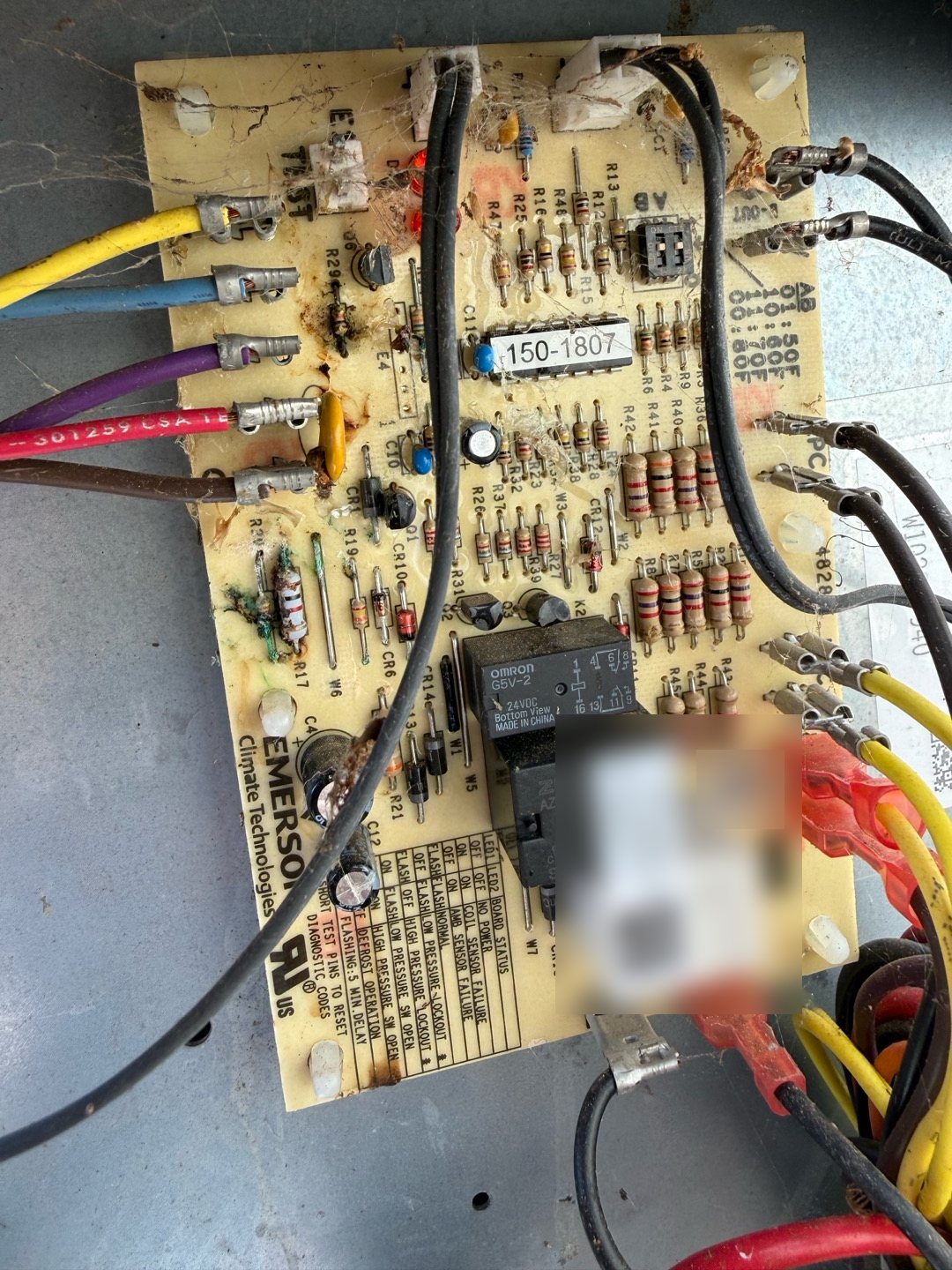
What's not normal is a heat pump that stays encased in ice. Trane's guidance is that if it keeps running but hasn't defrosted after an hour, you may need to call for heat pump repair. The usual causes are a failed defrost control board, a bad defrost sensor, a stuck reversing valve, low refrigerant, or an outdoor fan that isn't running. Sometimes it's simpler: water pouring off a clogged gutter onto the unit and freezing there.
Don't chip ice off the coil with a screwdriver or an ice scraper. The aluminum fins are thin, and the refrigerant tubes behind them are easy to puncture. You can gently pour lukewarm water over it, not boiling, if you want to see what's underneath, but the real fix is figuring out why the defrost didn't happen.
If you've had an AC freeze up in summer, the physics are related but the reasons are different. Our post on why an AC runs but doesn't cool covers summer ice in detail.
Why is my heat pump running all the time, or stuck on aux heat?
On a cold night, a heat pump running nonstop can be perfectly normal. It's designed to run long, steady cycles, and the colder it gets, the harder it has to work to pull heat out of the air. If the house is holding temperature, the system is doing its job.
It becomes a problem when the house can't hold temperature on a mild day, or when the thermostat shows "Aux" or "Emergency Heat" running most of the time. Electric heat strips are reliable, but they're the expensive way to make heat. DOE advises not setting back a heat pump's thermostat manually if it causes the backup electric-resistance heating to come on, because that heating is more expensive. If your bill jumps in January, a heat pump leaning too hard on its backup heat is one of the first things we check. Our FAQ also covers other reasons your energy bill might be so high.
A few things that cause it:
- Big thermostat swings. Bumping the thermostat up several degrees at once tells many systems to bring on the strips. Small changes let the heat pump catch up on its own.
- Emergency Heat left on. If someone switched the thermostat to Emergency Heat and forgot, the heat pump is sitting out entirely.
- A heat pump problem. Low refrigerant, a failing compressor, or a defrost problem can leave the heat strips doing all the work.
- Ducts and insulation. Leaky ducts in an unheated attic or crawlspace lose heat before it reaches the rooms, which the next section covers.
Why is my house still cold even though the heat is running?
Sometimes the furnace or heat pump is making plenty of heat, and the heat just isn't making it to you.
- Leaky or disconnected ducts. In a lot of homes across Fayette and Coweta County, the ductwork runs through attics and crawlspaces that are as cold as outside in January. A disconnected or torn duct can blow heated air straight into the attic insulation.
- One cold room. Usually a room at the end of a long duct run, over a garage, or with a closed or blocked vent. A bonus room over the garage is the classic case.
- Upstairs warm, downstairs cold. Heat rises, and a two-story house with one system often needs its vents balanced differently for winter than for summer.
- Undersized or oversized equipment. If a system was sized wrong at install, it can struggle on the coldest nights or cycle on and off without ever evening out the temperature.
- Drafty windows, doors, and attic hatches. DOE's point about the whole house matters here: heating equipment can only do so much against a house that leaks.
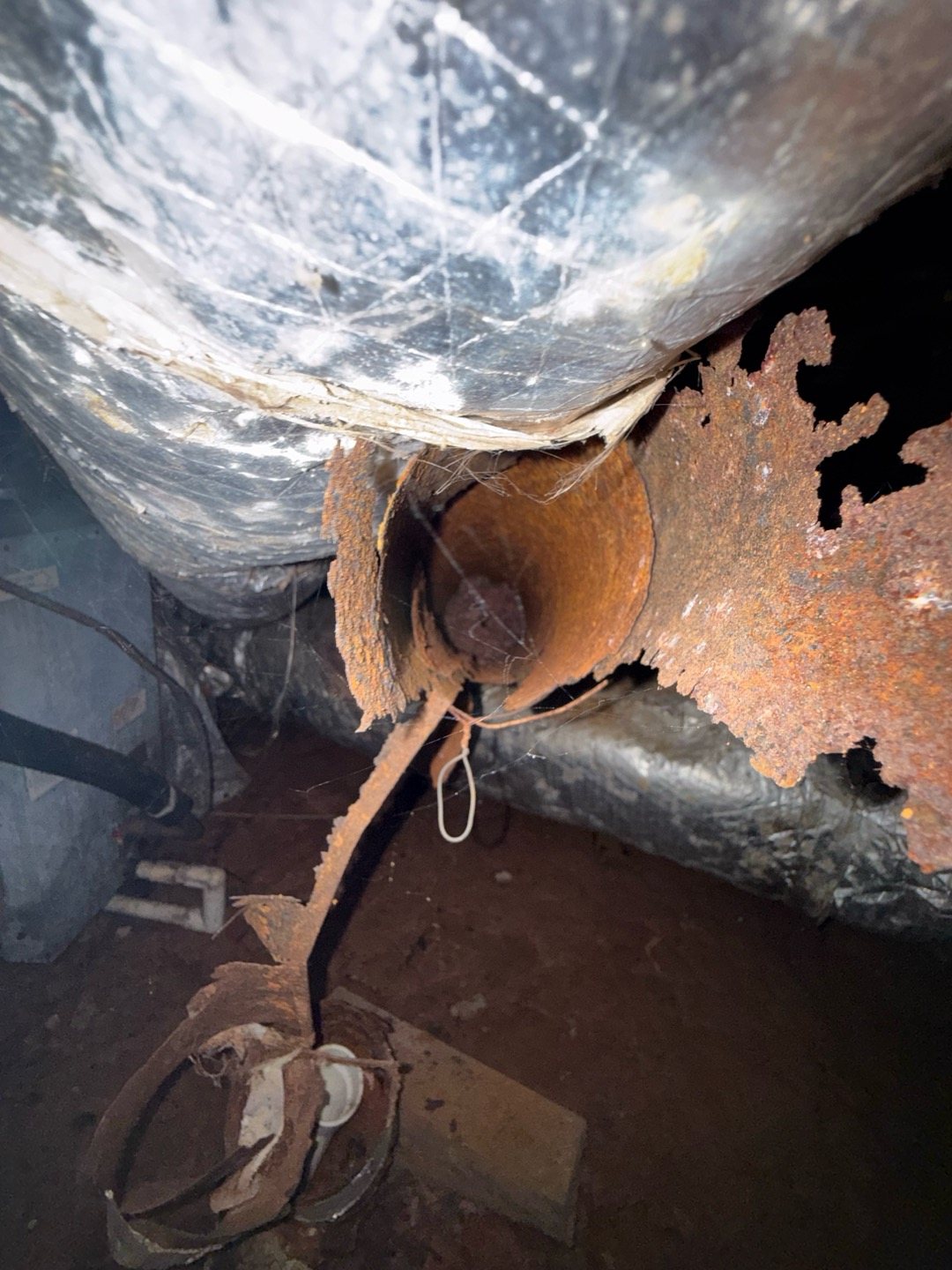
Crawlspace systems deserve a special mention. Georgia crawlspaces are damp, and damp air and steel don't get along. Over years, moisture can rust plenums, flue pipes, and furnace cabinets from the outside in. Rust holes in the wrong place leak heated air, let crawlspace air into the ducts, and on a gas furnace can mean exhaust isn't going where it's supposed to. It's the kind of problem nobody sees until a technician crawls under the house with a flashlight.
When should you turn off the heat and call a professional?
Some problems are fine to watch for a day. These aren't. Turn the system off at the thermostat and call us at 770-299-2833 if:
- You smell gas. Leave the house first, and call 911 or Atlanta Gas Light from outside.
- Your carbon monoxide alarm goes off. Get everyone out and call 911.
- You smell burning, hot wiring, or melting plastic. A little dusty smell the first time the heat runs in fall is normal, because dust on the heat exchanger is burning off. It should fade within an hour or so. A sharp electrical smell that doesn't fade is different.
- The breaker trips again after you've reset it.
- You hear banging, booming, or screeching. A boom at ignition can mean delayed ignition, where gas builds up before it lights. Screeching usually means a motor bearing or belt.
- You see soot or scorch marks around the furnace burners or vent.
- The burner flame is yellow and lazy instead of mostly blue and steady, if you can see it through the window.
- Water is pooling under or around the furnace.
- The heat pump's outdoor unit stays encased in ice.
What happens when a John Davis technician diagnoses a furnace or heat pump that won't heat?
When a furnace is not heating, the goal is to measure, not guess. Here's roughly what a no-heat diagnosis looks like when we come out:
- We ask what happened. When did it stop? Did it make a noise? Does it start and quit, or never start at all? Your answers narrow the list fast.
- We read the control board. The status light and its blink code tell us which step of the start-up sequence failed.
- We watch a full start-up. Thermostat call, inducer, pressure switch, igniter, gas valve, flame, blower. We see exactly where it stops.
- We test, instead of swapping parts. Flame sensor current, igniter resistance, pressure switch operation, gas pressure, voltage at the board, temperature rise across the furnace, and on a heat pump, refrigerant pressures and the defrost controls.
- We check for safety. We inspect the heat exchanger, the flue and venting, and test for carbon monoxide.
- We explain what we found before we fix anything, and we let you decide.
A lot of these calls end with a cleaned flame sensor, a new igniter, or a cleared drain line, not a sales pitch. If a part and a cleaning will get you through the next several winters, that's what we'll tell you. If the system is old and the repair is major, we'll walk you through repair versus replacement honestly, show you what we'd do in your shoes, and let you decide. If replacement makes sense, our HVAC replacement page explains how we approach it. We've been a family-owned and operated company serving South Atlanta since 1968, and neighbors call back the company that told them the truth. You can read more about our heating services and our general HVAC repair work.
How do you keep your furnace or heat pump from quitting this winter?
Almost every cause of a furnace not heating builds slowly. Flame sensors coat up a little at a time. Filters fill up. Drain traps grow sludge. Igniters weaken. Rust creeps. Then one cold night, the slow problem becomes a fast one.
- Get a fall heating tune-up. ENERGY STAR recommends checking the heating system in the fall, because contractors get busy once winter arrives. Our guide on how often to service your heating and AC covers what a real tune-up includes, and our preventative maintenance page explains how we do it.
- Run the heat before you need it. Turn it on for a few minutes on a cool October evening. If something's wrong, you'll find out before the first freeze, not during it.
- Check the filter monthly. It's the one maintenance job that's all yours. Our FAQ has more on how often to change your air filter.
- Test your CO alarms and replace their batteries when you change your clocks.
- Keep the heat pump clear. Pine straw, leaves, and gutter runoff are the enemies of an outdoor unit in winter.
- Keep the area around the furnace clear. No storage boxes, paint cans, or laundry piled against a gas furnace.
- Make small thermostat changes on a heat pump, a degree or two at a time.
How does the JD Air Care Plan help when your heat acts up?
If you'd rather not keep track of all that, the JD Air Care Plan does it for you. Plans start at just $15 a month, and members get:
- Two tune-ups a year, spring for cooling and fall for heating
- A $0 service fee when you need us
- Priority scheduling, so members get seen first when the weather turns
- 10% off repairs
- Free standard filters
The real value is in what doesn't happen: the flame sensor cleaned in October instead of failing on a Saturday in January, the cracked igniter caught at the tune-up, the drain trap cleared before it shuts the furnace down. Our phone line is answered 24/7, so you can always reach a person to get on the schedule. See the membership page for full details.
Furnace or heat pump not heating? Get Service Now
If your furnace or heat pump is not heating and the house is getting cold, call John Davis Heating & Air at 770-299-2833. We're a family-owned company working out of our shop at 1525 Senoia Rd Suite G in Tyrone, and we've been keeping homes warm across South Atlanta since 1968, including furnace repair in Tyrone, Peachtree City, Fayetteville, Newnan, and Senoia, plus the rest of Fayette County and Coweta County. See all of our service areas.